Mapped read technology

Enhance short-read genome sequencing with long-distance information using proximity mapped read technology, which powers TruPath Genome

abstract sequencing mapped reads

What are mapped reads?

Illumina sequencing has significantly advanced genome mapping methods, helping researchers achieve highly accurate coverage over the vast majority of the human genome.1 However, for a small percentage of the genome, mapping short reads to a reference genome remains challenging. These challenges primarily occur in repetitive or low-complexity regions, regions with high sequence homology, or large structural variations.

Proximity mapped read technology enables improved mapping in difficult-to-map regions of the genome, ultralong phasing of genetic variants, and enhanced detection of structural variants.

Thumbnail

Achieve accurate genome mapping with unprecedented simplicity

Proximity mapped read technology leverages on-flow cell library preparation and novel informatics that incorporate proximity information from clusters in nearby nanowells to generate long-range genomic insights. The unique and highly simplified workflow, available in the TruPath Genome assay, maintains the link between the original large DNA template and the resulting short sequencing reads.

Advantages of proximity mapped read technology

Proximity mapped read technology, which powers the TruPath Genome assay, uses a unique workflow that provides comprehensive genome analysis.

On-flow cell library prep creates the simplest sample to sequencer WGS workflow

XLEAP-SBS chemistry on the NovaSeq X Series provides proven accuracy and scalability of 2-16 samples per run

Cluster proximity analysis unlocks exceptional long-distance information

Enhanced mapping resolves challenging regions and delivers an enhanced genome

Novel method improves detection of large structural rearrangements

How does proximity mapped read technology work?

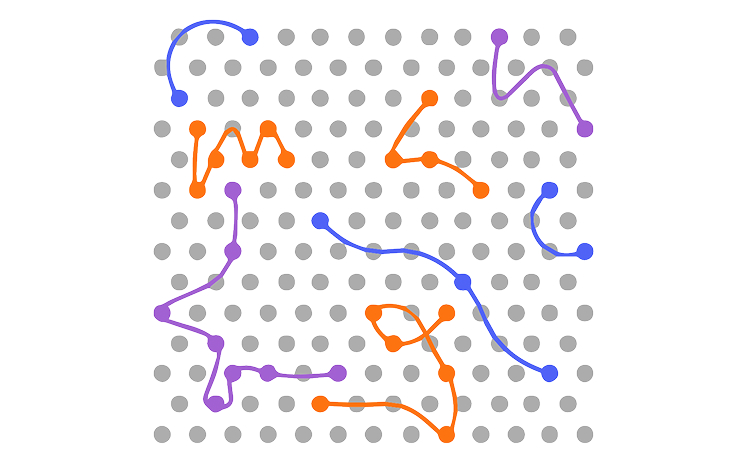
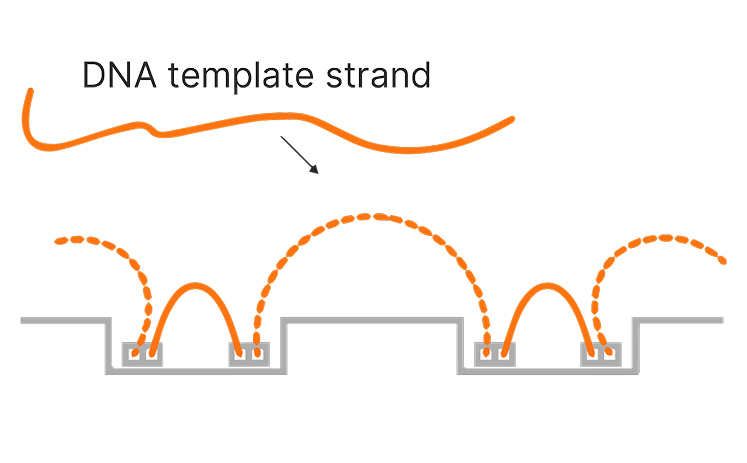
In proximity mapped read technology, DNA extracted using standard or high-molecular weight methods is introduced onto a flow cell grafted with tranposases. DNA fragments are captured in nanowells through a process called tagmentation, and then sequenced. By capturing large DNA fragments, proximal nanowells produce a constellation-like pattern that allows clusters to be mapped back to the original fragments using novel algorithms with DRAGEN Germline analysis. This combines the proven accuracy of short-read sequencing with long-distance genomic insights to significantly improve mapping of challenging-to-map regions, enhance structural variant detection, and deliver ultralong phasing.

Figure 1a: Top view of constellation pattern

Figure 1b: Side view of constellation pattern

Figure 1b: Side view of constellation pattern

Figure 1: DNA attaches to the flow cell in a constellation pattern. The top view illustrates a small percentage of the tile showing DNA strands across the flow cell. The side view illustrates the template DNA undergoing tagmentation on the flow cell.

Proximity mapped read workflow

Powered by proximity mapped read technology, TruPath Genome enables human germline whole-genome sequencing (WGS) with improved coverage, higher accuracy variant detection, and unprecedented simplicity. On-flow-cell library prep eliminates standard library prep prior to sequencing.

1
Prep
2
Sequence
3
Analyze

Hear from experts

Thumbnail

Perspectives on proximity mapped read technology

Dr Stephen F. Kingsmore from Rady Children's Institute for Genomic Medicine shares his perspective on proximity mapped read technology and its potential impact on rapid WGS for rare genetic disease.

Thumbnail

Mapping the future of WGS

Dr Joseph Devaney, Director of Laboratory Innovation Team at GeneDx, compares data and shares his perspectives on the potential impact of proximity mapped read (formerly constellation) technology.

Thumbnail

Performing analysis with mapped read technology

Louise Fraser, PhD, Associate Director in Assay Research and Development at Illumina, describes how mapped read technology, formerly constellation mapped reads, works and the types of analysis that can be performed.

Illumina innovation roadmap for multiomics research

Hear Dr Steven Barnard from Illumina describe the latest Illumina innovations enabling revolutionary multiomic applications. Dr Niall Lennon from the Broad Institute of MIT gives his impressions on the workflow, early data, and exciting potential of proximity mapped read technology.

FAQ

Proximity mapped read technology is currently available for the NovaSeq X Series. Analysis uses the DRAGEN Germline secondary analysis pipeline and is compatible with the Illumina whole-genome tertiary analysis solution.

Proximity mapped reads are standard short reads combined with proximity information from clusters in nearby nanowells to generate accurate long-range genomic insights. The workflow maintains the link between the original large DNA template and the resulting short reads for detecting structural variants, ultralong phasing of genetic variants, and improved resolution of difficult-to-map regions of the genome.

No, the experimental workflow does not require modifications to the sequencing system. The method only requires a novel sequencing recipe, making it readily accessible to researchers.

Long-read sequencing enables sequencing of intact long DNA molecules. The mapped read technology workflow introduces long template DNA directly to a patterned flow cell; proximal nanowells have a high probability of containing DNA from the same template. Reads can be informatically mapped with high confidence for applications that include detection of large structural variations, mapping low-complexity regions, and ultra-long phasing of variants.

Read mapping describes the process of determining the genomic location from which a sequence read originates. Alignment involves identifying similarities between two or more sequences. For example, a single read can align to more than one place in the genome but will only accurately map to one. Mapped read technology supports both mapping reads to a reference genome and alignment analysis.

/ Results

Additional resources

Thumbnail

Dr Steve Barnard introduces mapped read technology

Steve Barnard, PhD, CTO of Illumina, introduces constellation-mapped read technology for human genome sequencing, joined by Niall Lennon, PhD, Chair and CSO of Broad Clinical Labs, sharing preliminary data and insights.

Related content

Human whole-genome sequencing

Get an unbiased view of the entire human genome and evaluate the genetic variants that encode human traits and disease.

Rare disease genomics

Genomics is driving a fundamental shift in understanding the genetic variants underlying rare diseases. 

Long-read sequencing

Gain deep insights into complex regions of the genome such as highly repetitive regions, large inversions, and translocations.

Ready to speak to someone?

Learn how proximity mapped read technology, which powers TruPath Genome, can help you unlock long-distance genomic information and novel insights.

References

  1. Behera S, Catreux S, Rossi M, et al. Comprehensive genome analysis and variant detection at scale using DRAGEN. Nat Biotechnol. Published online October 25, 2024:1-15. doi:10.1038/s41587-024-02382-1